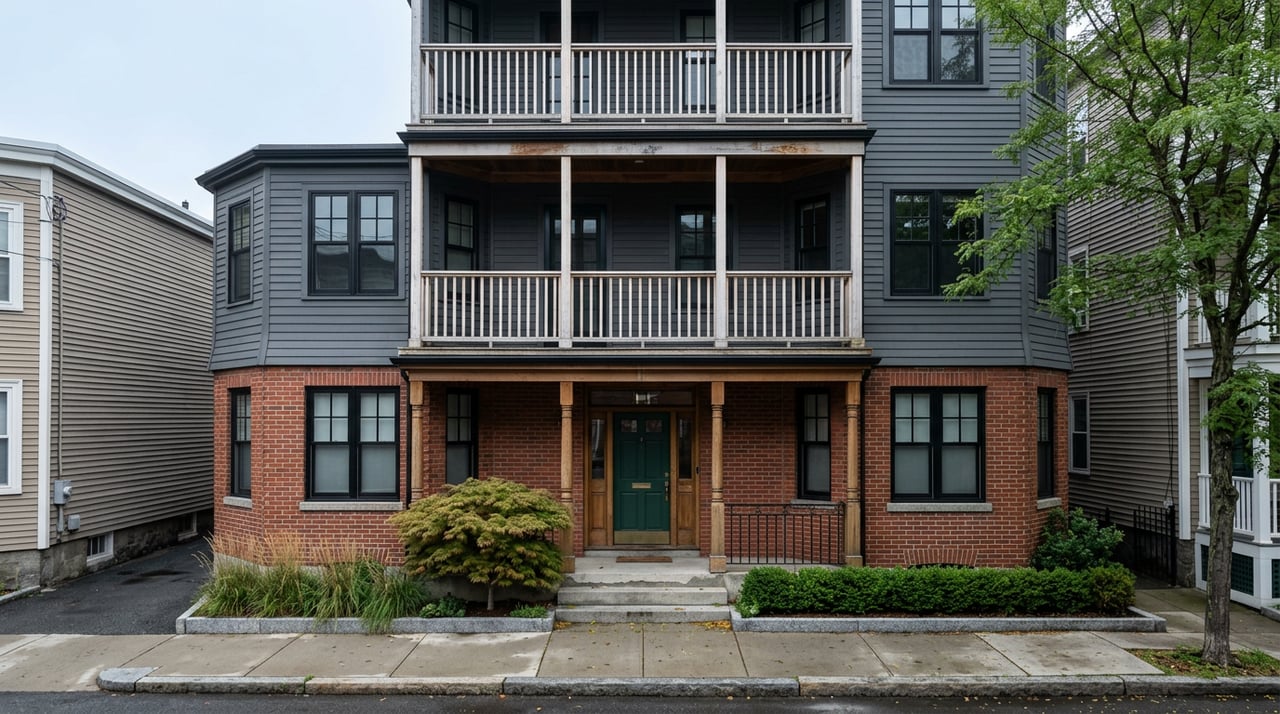
If you own a Somerville two- or three-family and you have been holding a "someday we'll condo it" plan in your back pocket, the plan changed on October 1, 2025. The city rewrote the Condominium Conversion Ordinance. The paperwork looks similar. The clock and the check do not.
The short version: for owner-occupied buildings and vacant non-rentals, conversion is still a live option. For buildings with sitting tenants, the arithmetic has quietly tipped toward selling the property intact.
The clock is the real friction
The ordinance has existed in some form since 1985. What the 2025 amendments did was stretch the timeline and raise the price of moving tenants out on your schedule. Property owners must now give a minimum of two years' notice to the Condominium Review Board before receiving a final permit to convert a vacant, formerly tenanted unit into a lawful condominium, up from one year previously. For tenants who are elderly, disabled, or low-to-moderate income, the notice period has been extended from two years to five years in the updated ordinance.
Read that again with a listing calendar in mind. A three-family with one senior tenant on the second floor is a five-year decision, not a spring-market decision.
Relocation payments moved in the same direction. Standard relocation payments rose from $7,546 to $14,000, and enhanced payments for seniors, disabled, and low-to-moderate income tenants rose from $12,577 to $18,000, both subject to annual CPI adjustments. On a fully tenanted three-family with one qualifying enhanced tenant, that is up to $46,000 in relocation checks before you print a marketing brochure.
What the new numbers cost you, by scenario
The ordinance treats three property situations very differently. Here is the compressed version.
| Situation | Notice / Waiting Period | Relocation Cost Exposure | Permit Path |
|---|---|---|---|
| Owner-occupied, no tenants in last 12 months | None | $0 | Preliminary Non-Rental Conversion Permit |
| Formerly tenanted, now vacant | 2-year wait before final permit | Possible if displacement is scrutinized | Preliminary Rental, then Final |
| Currently tenanted, standard tenant | 1-year notice | $14,000 per unit | Preliminary Rental, then Final |
| Currently tenanted, enhanced-protection tenant | 5 years, extendable up to 2 more if no comparable housing found | $18,000 per unit | Preliminary Rental, then Final |
| New construction, never rented | None | $0 | Courtesy Permit |
Enhanced tenants also carry a 180-day right of first refusal after the notice to convert, versus 120 days for standard tenants. If the tenant does not make an offer inside that window, the converter cannot then sell the unit at a price more favorable than what was offered to the tenant. That last clause quietly caps your upside if you try to shortcut the process.
The permit tiers, in plain English
Under the revised framework, the Condominium Review Board processes four kinds of permits, and confusing them is the single most expensive mistake a first-time converter makes.
- Preliminary Non-Rental Conversion Permit. For owner-occupied or non-rental units. No waiting period. This is the fastest path and it belongs to owners who never rented the unit out or who have not had a tenant in the previous twelve months.
- Preliminary Rental Conversion Permit. For units previously rented. Roughly a one-to-two-year waiting period depending on tenant status.
- Final Conversion Permit. Granted once all conditions, relocation payments, and documentation are satisfied. This is when the master deed can be recorded.
- Courtesy Permit. For newly constructed units that were never rented. Moves through the process more quickly.
The CRB meets monthly on the last or second-to-last Monday at 6 p.m. Applications must be filed with the OSPCD Housing Division at 50 Evergreen Ave at least three weeks before the hearing so tenants can receive the required two weeks' notice. Miss that window and your application rolls to the following month. On a two-year timeline, one missed filing is not fatal. On a listing you hoped to activate this fall, it is.
When conversion still pencils
Run the numbers before you run the process. Under the 2026 Somerville market, condos closed at an average of $952,000 across 156 year-to-date sales with a 100.5% sale-to-list ratio and 31 average days to offer, while single-family homes averaged $1.57M across 26 sales at a similar 100.9% ratio. Multi-family listings on the open market are ranging from roughly $849,000 to well past $2M for typical two- and three-unit stock, with a median around 30 days on market.
The conversion premium exists. Three separate condos out of a well-located three-family will almost always outrun the whole-building price a single investor will pay, especially near Davis, Porter, Union, or the Green Line Extension stops. Conversion still pencils when:
You own the building outright, live in one unit, the other units are either vacant or occupied by cooperative tenants who plan to buy, and your capital can wait 18 to 30 months for master-deed-to-close.
That is a narrow door, but it is a real door. The owner-occupied non-rental path skips the waiting period entirely, which is why the ordinance quietly rewards long-term resident landlords over out-of-town investors.
When selling the multi-family as-is beats converting
If any of the following describe your property, the 2025 amendments have probably closed the conversion door for the current cycle:
- You have a tenant who qualifies as elderly, disabled, or low-to-moderate income. The five-year notice window is longer than most sellers' actual planning horizon, and any attempt to deliver the building vacant will be reviewed by the CRB looking back through tenancy history.
- Your building has been rented within the last 12 months and is now vacant. The two-year wait applies, and the Board now closely reviews tenancy history, notice compliance, and relocation proof before granting final conversion approval.
- Your capital is time-sensitive. Multi-family buyers, including 1031 exchangers and small local investors, are closing in the 30-to-45-day range at ratios near list. A 24-month conversion arc has a real opportunity cost against that.
- Your relocation exposure is a meaningful percentage of the conversion premium. If a $14,000-to-$18,000 check per unit, plus legal and CRB filing costs, plus the two-year carry, eats more than the spread between the three individual condo values and the whole-building sale price, you are working for the tenants and the attorneys.
The counterintuitive read: Somerville's ordinance has not banned conversion. It has repriced conversion into a project only well-capitalized, patient, and mostly owner-occupied sellers should attempt. Everyone else is now a multi-family seller whether they planned to be or not.
A pre-decision checklist
Before you commit to either path, work through this in order:
- Pull the tenancy history for the last 12 months for every unit, including short-term arrangements.
- Confirm whether any current or recent tenant qualifies as elderly, disabled, or low-to-moderate income under the ordinance's definitions.
- Get a realistic three-unit condo comp set for your specific block, not for Somerville broadly.
- Get a whole-building multi-family valuation on the same address.
- Model the carry cost of a 24-month wait: taxes, insurance, deferred maintenance, and the interest cost of tied-up equity.
- Price the relocation exposure at $14,000 or $18,000 per unit for every currently tenanted unit.
- Only after those seven inputs are on paper, choose a path.
If steps three and four are close, sell as-is and take the certainty. If step three beats step four by more than the sum of steps five and six, and you fit the owner-occupied profile, conversion may still be the right move.
FAQ
Does the ordinance apply to two-family homes? Yes. The revised ordinance covers two- and three-unit properties, which was the significant expansion from earlier versions.
Can I evict a tenant during the notice period? No, except for a substantial violation of the lease, and not to facilitate the sale of a condominium unit. Interrupting essential services or altering the terms of the tenancy during the notice period will kill the application.
What if my building is brand-new construction and was never rented? A Courtesy Permit applies and generally moves more quickly. This is the path most infill developers use.
Do I have to offer units to tenants first? Tenants have a 120-day right of first refusal, or 180 days if they qualify for enhanced protections. If they decline, you may sell on the open market, but not at a price more favorable than the one offered to the tenant.
The 2025 amendments did not make Somerville less valuable. They made the timing of value harder to control. If you own a two- or three-family and you are trying to decide whether to hold, list intact, or begin a conversion clock, that decision now depends on your specific tenant roster and your patience, not on a formula that used to work for everyone. The Encompass Group works through this analysis with Somerville owners every week and can model both paths against your building before you file anything. Schedule a consultation, or start with a home valuation if you want the multi-family number first.