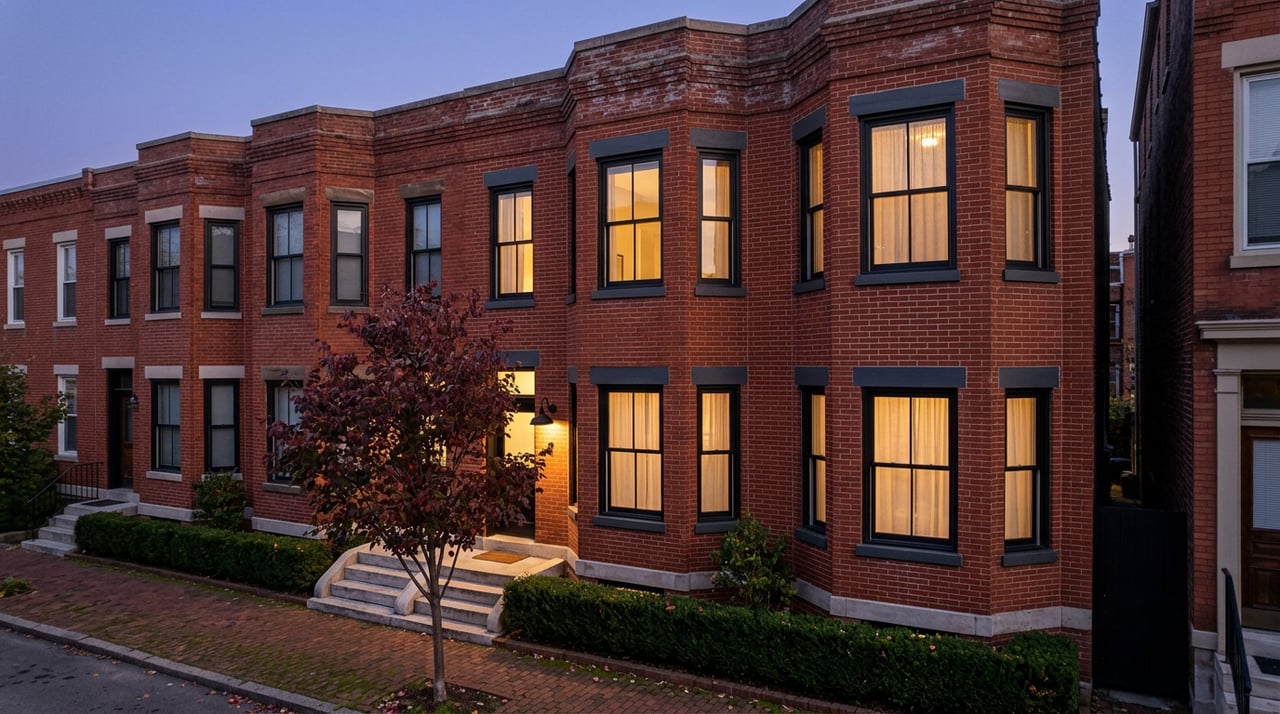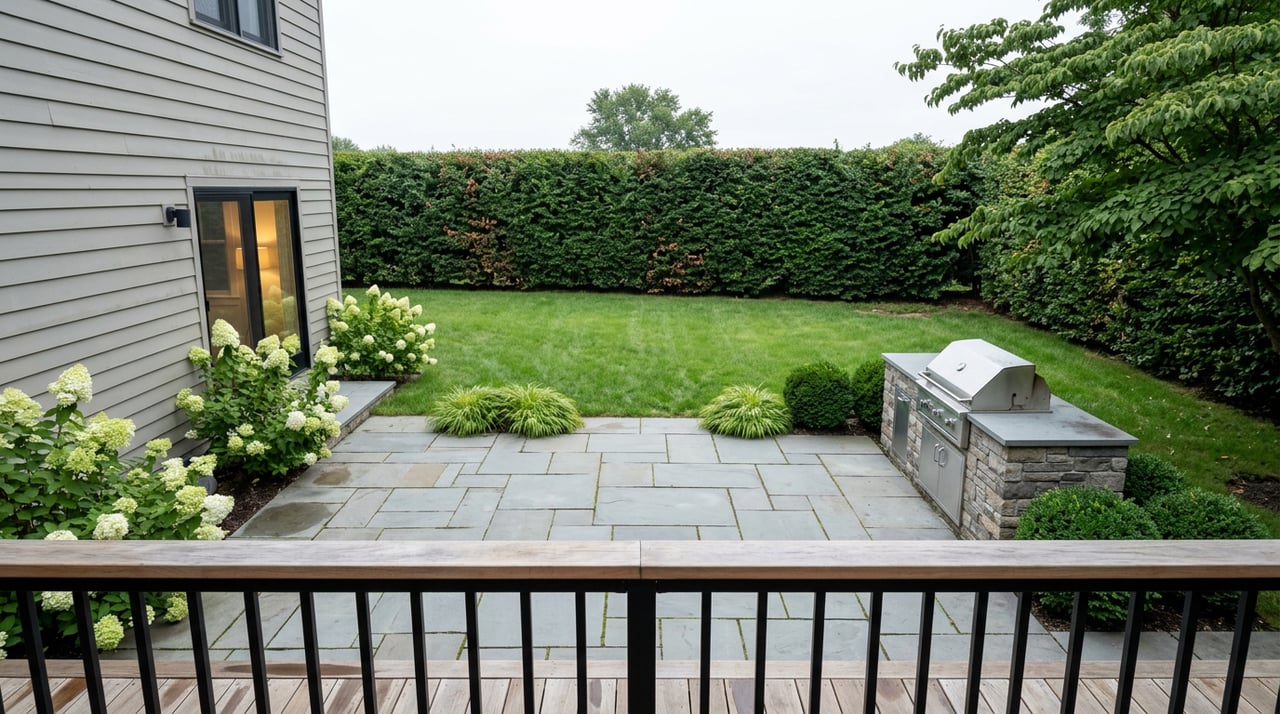
Pull up three different sources for the Winchester housing market this summer and you will get three different stories. One closed-sale tracker puts the median down 26.3 percent year over year for the three months ending in May 2026, a drop steep enough to make an owner reconsider a listing date. A separate estimate index, built from smoothed home values rather than actual closings, shows the market up 1.2 percent over the same stretch. A third source, pulling the full 2025 calendar year straight from MLS PIN, the system Massachusetts agents actually transact on, puts the median up 16.46 percent from 2024.
None of these numbers is lying. They are answering different questions, and in Winchester right now, the question matters more than the answer.
The math nobody runs before quoting a percentage
Winchester has about 21,000 residents. It is not a volume market. In February 2026, one closed-sale tracker recorded 23 total home sales for the entire town. By May, another tracker counted 61. A single calendar month in Winchester can swing from two dozen closings to five dozen, and every one of those closings is a data point in a median that gets reported as if it were drawn from a stable, representative sample.
It is not. A median built from 23 sales is a median built from 23 sales. If three of those are teardown lots on the Woburn line and none are lakefront, the number tells you almost nothing about what a buyer competing for a renovated colonial near the town center will actually pay. Add or remove a couple of high-end closings on Upper or Lower Mystic Lake, where waterfront homes carry private docks and beach rights and routinely clear $2.5 million to $8 million, and the reported median can lurch double digits in either direction without a single ordinary home changing in value.
Here is what the different measures showed:
| What the number measures | Time window | Reported move |
|---|---|---|
| Closed sales, trailing 3 months | Through May 2026 | Median down 26.3% year over year |
| Home-value estimate index (all homes, not just sales) | Mid-2026 | Up 1.2% year over year |
| MLS PIN, full calendar year | 2025 vs. 2024 | Median up 16.46% year over year |
| Closed sales, single month | February 2026 | Median near $2 million from 23 closings |
Price per square foot tells the same conflicting story. One tracker had it at $526 in the trailing three months through May, down 11 percent year over year. The MLS PIN full-year figure for January 2026 put it at $604, up 17.9 percent. Both numbers describe Winchester. Neither describes it completely.
The neighborhood data makes the point better than the citywide number
If the citywide median is unreliable because of sample size, the fix isn't to trust a different citywide number. It's to look at what happened inside a single, well-defined submarket, while keeping the different reporting periods in mind. Winchester's West Side neighborhood, tracked separately from the town's overall figure, showed a median sale price of $1.7 million for the three months ending in June 2026, up 6.7 percent year over year, on 15 closings, up from 14 the year before.
In the same town, the West Side submarket moved in the opposite direction from the headline figure by more than 30 points. That gap shows why reporting periods and submarkets matter when comparing median prices.
The story that actually explains where Winchester is headed
If the median can't tell you what's happening in Winchester right now, the project positioned to be the first transit-oriented development to break ground in town can.
The Waterfield lot next to the Winchester Center commuter rail station has served as commuter parking for years. In 2018, Town Meeting approved selling it on the condition that whatever got built there include affordable housing. A land development agreement with Civico Development cleared Town Meeting in 2021, only for opponents to gather enough signatures to force a townwide referendum. That vote killed the original deal by two points, 51 to 49, and sent the town back to the negotiating table.
A revised design, this time from architect Union Studio and still led by Civico, won Planning Board approval on February 6, 2024. The plan calls for 56 units on the site, including affordable units restricted to households earning 60 percent of area median income or below, with some set aside for households at or under 30 percent of AMI, including some households transitioning out of homelessness, as well as units at market rent. The project, now called Waterfield Commons, is budgeted at roughly $43 million and is pursuing Passive House certification alongside EV charging and bike parking.
On July 31, 2025, Governor Maura Healey and Lieutenant Governor Kim Driscoll came to Winchester to announce $182 million in low-income housing tax credits and subsidies across 21 sites statewide, creating or preserving 1,245 homes. Waterfield Commons was one of them.
"This project embodies the kind of housing our region urgently needs, resilient, inclusive and thoughtfully integrated into the fabric of the community," said Causeway Development principal Dave Traggorth, whose firm is partnering with Civico on the build.
As of September 2025, the most recent detailed reporting available on the project, shovels were still not in the ground. Civico's Taylor Bearden said the remaining work was finalizing the ground lease terms with the town, a process he estimated could take up to a year. That timeline puts a plausible groundbreaking sometime around now, but there is no public confirmation of an actual start date, so treat "under construction" as a question to ask rather than an assumption to make. What is confirmed is that Waterfield Commons sits directly next to the recently renovated Winchester Center MBTA station, and that the town separately has a downtown streetscape overhaul in the works, with Toole Design Group developing construction plans for traffic calming along Main Street between the Quill Rotary and Mystic Valley Parkway.
What to actually watch instead of the headline median
If you are weighing a purchase or a listing in Winchester right now, the citywide median swing is close to noise. These are the things worth tracking:
- The ground lease status on Waterfield Commons, since that is the gating item before construction can start
- Submarket-level pricing (West Side, Winchester Center, the Flats) rather than the townwide figure, given how thin the overall sample is
- Days on market and offer counts in your specific price band, since a $1.2 million colonial and a $3 million lakefront property are not competing in the same pool of buyers
- Progress on the Main Street streetscape work, which will change how downtown Winchester Center feels to walk through over the next few years
What this means if you're comparing Winchester to Somerville, Cambridge, or Medford
Buyers moving up from Somerville or Cambridge tend to arrive in Winchester expecting a straightforward trade: less walkability for more space and a faster commute. That trade still holds. Winchester's own walkability tools rate it in the low 40s, nowhere close to Somerville or Cambridge, but the Winchester Center station is an 18 to 22 minute ride to North Station on the Lowell Line, one of the shorter commuter rail hops into Boston.
What's changed is that Winchester is, for the first time in years, adding meaningfully to its downtown housing stock rather than relying purely on turnover of existing homes. That matters less for today's for-sale inventory (Waterfield Commons is a rental building) and more as a signal of where the town is willing to grow. A town that spent three years fighting over 56 units next to its own train station is not a town where large-scale change comes quickly. If you're the kind of buyer who values knowing what's coming rather than reacting to what already happened, that slow, contested pace is itself useful information.
If you want a fuller side-by-side on what a move from Somerville or Cambridge to Winchester actually involves, our guide for move-up buyers and our budget breakdown for Winchester luxury purchases go deeper on both fronts.
FAQ
Is Waterfield Commons for sale or for rent? Rental. All 56 units, both the affordable and market-rate portions, are structured as rental housing. It will not add directly to Winchester's for-sale inventory, but it does signal how the town is treating its downtown parcels going forward.
When does construction actually start? No public start date has been confirmed. The last detailed update, from September 2025, put the remaining hurdle at finalizing the ground lease between the town and the developers, a process estimated at up to a year from that point. Given that timeline has likely already elapsed, it's worth confirming current status directly with the town before assuming the project is still pre-construction.
Does a falling median mean it's a buyer's market in Winchester? Not on its own. The reported drop is largely a function of which homes happened to close in a given month, not a broad repricing. Price per square foot in the same window told the opposite story depending on which full-year dataset you check.
Why did the West Side neighborhood number move in the opposite direction from the citywide figure? Because the citywide figure is drawn from a small, uneven pool of monthly closings, while the West Side number reflects a more consistent, geographically specific set of sales. In a town this size, the neighborhood-level number is often more trustworthy than the townwide one.
If you're trying to figure out what a specific Winchester address is actually worth in this market, rather than what the townwide median says it's worth, John Raposo can walk through the comparable sales that apply to your submarket, not the citywide average. Schedule a consultation to get a read on your specific street, not the whole town.